In most real encounters, the contest isn’t decided by who is stronger or even who shoots straighter. It’s decided by who reads the situation and acts on it first. The half-second between recognising what’s happening and doing the right thing about it is where outcomes are won and lost — and it’s one of the hardest things to train, because a static range measures whether you can perform an action, not how fast you can decide to.
The skill a range can’t measure
Conventional training is good at building technical execution. It’s far weaker at building decision speed, because most training environments remove the decision entirely. On a flat range, the trainee already knows what’s coming and what to do about it; the only variable is execution. But real situations invert this. The execution is often the easy part. The hard part is the rapid, high-stakes read — what is this, is it a threat, what do I do, and the realisation that hesitating is itself a decision, usually a bad one.
A trainee can be technically excellent and still freeze when the situation is ambiguous and the clock is running. That hesitation isn’t a flaw in their technique; it’s a gap in their training, because the speed of decision was never something they practised.
What VR puts under the clock
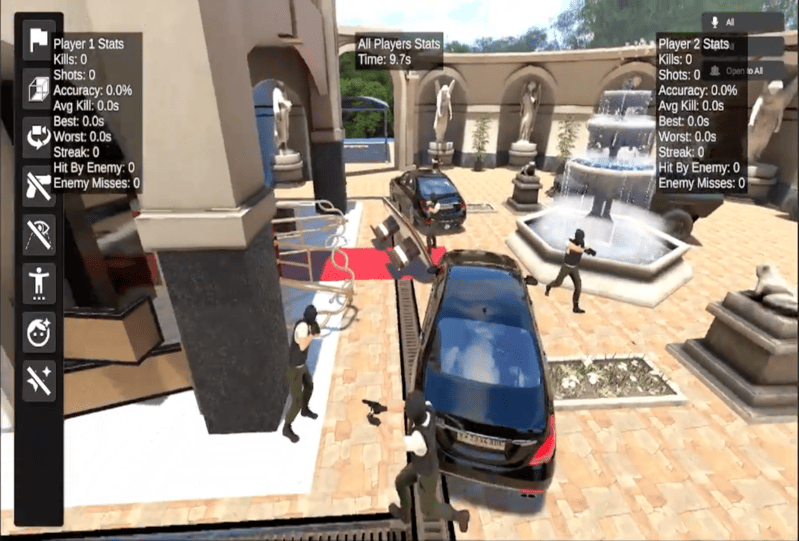
This is where immersive training reaches something the range can’t. A VR scenario can present situations that develop fast and unpredictably, forcing the trainee to observe, decide, and act under genuine time pressure — over and over, in varied situations. The thing being trained isn’t the action; it’s the speed and quality of the read that precedes it.
Indonesian developer KOMINA has built its platform around exactly this kind of pressure, including physical feedback that raises the stakes of a wrong or slow call. Repetition under that pressure is what compresses the decision loop. The first time a trainee faces a fast, ambiguous situation, they’re slow because they’re thinking consciously through every step. After many reps, the read becomes faster and more automatic — the right call arrives sooner because the pattern is familiar.
The debrief that shows the hesitation
There’s a measurement advantage that conventional training simply can’t match. After a VR scenario, the after-action data can show exactly where the trainee hesitated — the moment recognition should have triggered action but didn’t, the half-second that was lost. That turns a vague “you were slow” into a specific, coachable point: here is where you paused, here is the cue you should have acted on. Decision speed stops being an intangible quality and becomes something you can see, measure, and improve.
The limit worth naming
VR can’t reproduce every pressure of a real encounter — the genuine fear, the full physical stress, the irreversible consequences. It builds decision speed; it doesn’t manufacture courage or replace live experience. A faster loop in a headset is preparation, not proof.
But it attacks the precise weakness that gets people hurt: the gap between knowing what to do and deciding to do it fast enough. By drilling that loop until the right call comes quickly under pressure, VR helps ensure that in the half-second that decides an encounter, the trainee is already moving.
Technique keeps you in the fight. Speed of decision is what wins it — and it’s the half that most training forgets to drill.