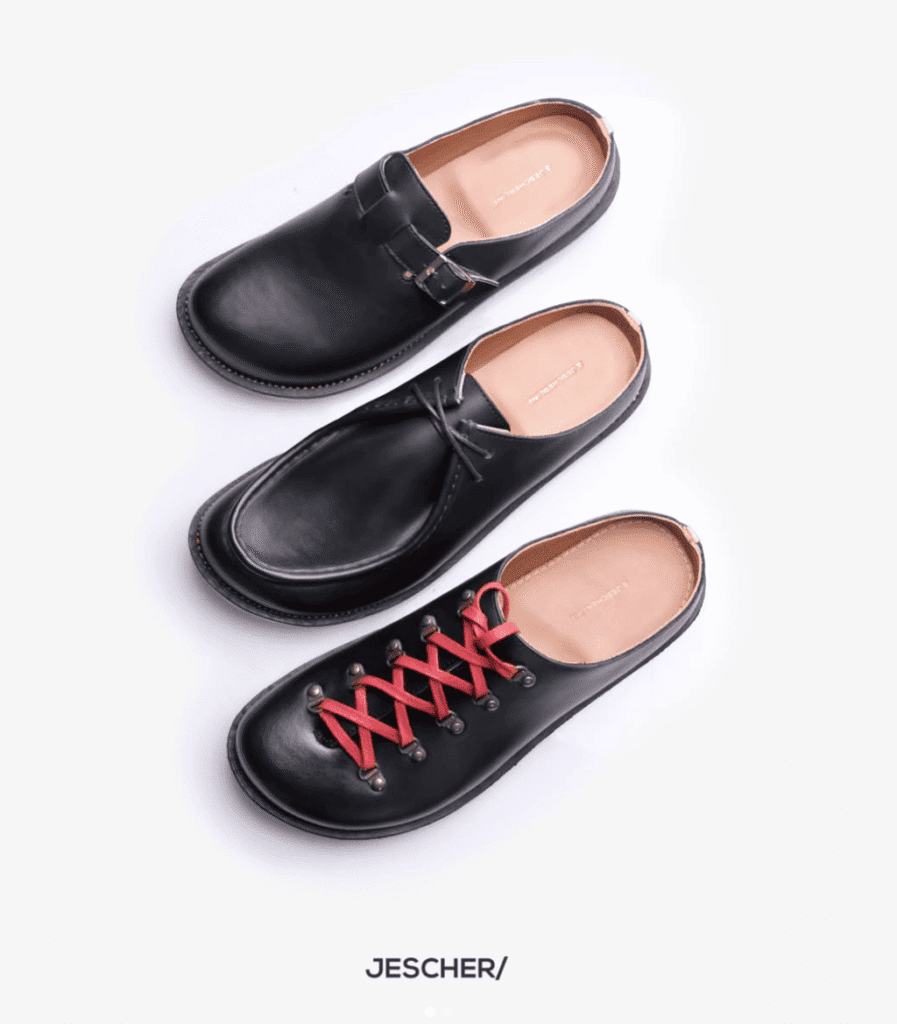
There’s one question that often pops up when someone first holds a pair of handmade leather sandals: “Why is the price so different from factory-made sandals?” That question is fair. At a glance, both products look like sandals, with straps, soles, and footbeds. But the moment we step into the production process, the gap between the two turns out to be remarkably wide.
To paint a clearer picture, let’s trace how a pair of handmade leather sandals is actually made. As an example, we’ll follow the approach taken by Jescherline, a Bandung-based brand known for consistently producing handmade leather sandals at a premium smart casual footwear standard. Here are the 5 main stages a pair goes through before it reaches your feet.
1. Leather Selection: The Most Crucial Stage That’s Often Overlooked
Every process of making handmade leather sandals begins with one fundamental step, leather selection. Many people assume that leather is simply cut and sewn, when in fact, this is the stage where the difference in quality starts to become clearly visible.
In mass-production factories, the leather used is typically split leather or bonded leather, which is cheap and uniformly graded. In contrast, for premium handmade leather sandals, brands like Jescherline use full-grain leather processed through vegetable tanning. Vegetable tanning is a leather treatment method that uses tannins from plants and tree bark instead of harsh chemicals. The process can take several weeks, far longer than chrome tanning, which usually finishes within hours.
Once the leather is ready, artisans don’t immediately cut it. They inspect each hide to ensure there are no major defects, that the leather thickness is consistent, and the color is uniform. The best sections are allocated for the strap or the most visible parts, while other cuts are used for the inner section or lining. An approach like this would be nearly impossible to apply in factories targeting thousands of pairs per day.
2. Pattern Making and Manual Cutting
After the leather has been selected, the next stage is pattern making. Each model of handmade leather sandals has its own pattern, ranging from strap shapes, stitch hole positions, to footbed contours. These patterns are usually made from sturdy materials like thick cardboard or plastic, and stored for repeat production.
What’s interesting is that at workshops like Jescherline, leather cutting is still done manually using specialized knives. Not because they don’t have machines, but because manual cutting offers far more precise control over the direction of the leather grain. Every piece of leather has its own grain pattern, and an experienced artisan can read that pattern to ensure the sandal strap has maximum strength at the points that bend most often.
The result is that two sandals of the same model can have slightly different visual characters because the position of their leather grain isn’t identical. For consumers used to factory-level uniformity, this might feel unusual. But for handmade leather sandals enthusiasts, that’s exactly where the value lies. Each pair has its own identity that can’t be duplicated.
3. Stitching: Where the Artisan’s Skill Is Truly Tested
The stitching stage is one of the most critical points in the production of handmade leather sandals. Here, every bit of an artisan’s skill is genuinely put to the test. Proper leather stitching requires a combination of hand precision, an understanding of thread tension, and considerable patience.
Some characteristics of premium handmade leather sandal stitching that you typically won’t find in mass-market products:
- The use of waxed thread that’s more resistant to humidity
- The saddle stitch technique, which produces two parallel stitches on the top and bottom of the leather
- Consistent spacing between stitch holes, usually with very tight tolerances
- Final knots that are hidden so they don’t easily come undone
Jescherline practices these techniques consistently. Each of their models, whether ARMADILLOS, BAFFARŌ, ELEFANTE, or VIZILO, is built with stitching designed to last far longer than that of factory-made sandals. One of the simplest indicators for checking the stitching quality of handmade leather sandals is to look at the back of the strap. If the stitching is neat and the tension is uniform, that’s a sign the artisan is experienced.
4. Footbed and Sole Assembly: The Stage That Determines Comfort
After the straps are sewn together, the next stage is the assembly of the footbed and sole. This is the part that directly affects comfort during wear. No matter how good the leather is, if the footbed isn’t ergonomic or the sole isn’t flexible, the sandals will still feel less than comfortable.
In premium handmade leather sandals, the footbed is usually built in layers with contours that follow the shape of the foot. The top layer is generally smooth leather that will form an imprint of the wearer’s foot over time, while the middle layer provides structure and arch support. The outer sole is typically made from leather, natural rubber, or a combination of both.
At Jescherline, particular attention is given to this aspect of comfort. Many of their users describe wearing the sandals as a kind of near-barefoot comfort, the feeling of walking unshod while still receiving the structure and protection proper footwear provides. This kind of sensation can only be achieved when the footbed material, sole thickness, and ergonomic contour are designed properly from the start. It’s no surprise that this stage typically takes the longest of all the assembly steps.
5. Finishing and Quality Control: Small Details That Make the Difference
The final stage is finishing and quality control. Many people think this is just a clean-up step before the product is shipped, when in reality, this is the stage where the premium character of handmade leather sandals is truly shaped.
A few things that typically happen during this stage:
- Edge painting, the process of coloring and smoothing the originally rough leather edges
- Burnishing, the process of polishing leather to achieve a natural sheen
- Light conditioner application to moisturize the leather before packaging
- Final inspection to make sure there are no production defects
- Alignment of right and left sizing to ensure symmetry
At Jescherline, this stage also includes packaging that pays attention to sustainability. The sandals are packed in biodegradable boxes and reusable cloth bags, so they don’t add to single-use plastic waste. Details like these may seem small, but they reflect a brand philosophy that’s consistent from start to finish.
Once all stages are complete, a pair of handmade leather sandals can finally be considered ready. The total time from leather selection to the finished product can take several days per pair, depending on the complexity of the model. Compared to factory-made sandals that can be finished in mere minutes, this difference explains why the two product categories sit at very different price points.
Getting to Know the Character of Several Jescherline Handmade Leather Sandals Models
After understanding the production process, we can better appreciate the character of each handmade leather sandals model from Jescherline. Here are a few of them:
- ARMADILLOS, a slip-on sandal with refined stitching and a sleek silhouette, flexible for daily wear
- BAFFARŌ Windsor Tan, with warm leather tones and a contemporary classic aesthetic
- ELEFANTE Black Ripple, for those who appreciate modern detailing thanks to its signature ripple sole
- VIZILO Suede Tan, a softer choice thanks to its suede texture and relaxed appearance
The character of each model isn’t just about aesthetics, but also reflects the decisions made at every stage of its production. From leather selection, pattern making, stitching, to finishing, all of it is interconnected to produce a final product that has been thoughtfully crafted from the start.
Closing Thoughts: Understanding the Process, Appreciating the Result
One of the best ways to appreciate a pair of handmade leather sandals is by understanding how they’re made. Once you know that behind a simple pair of sandals lies a long process involving careful leather selection, manual cutting, precise stitching, ergonomic assembly, and detailed finishing, you’ll have a more complete context for why this kind of product deserves a place in the serious smart casual footwear category.
For those who want to see firsthand the result of all these processes, the full collection of handmade leather sandals from Jescherline is available on their official website at jescherline.com. Owning a pair made through this kind of process is more than just acquiring footwear, it means becoming a small part of the local craftsmanship ecosystem that continues to be sustained by artisans’ hands in Bandung.